

Band management for indie bands: a practical guide
How to organise an indie band - song versions, feedback, setlists, gigs, money, and sending music to labels - without a manager or a stack of subscriptions.
By @KHeavy · Updated 26 October 2026
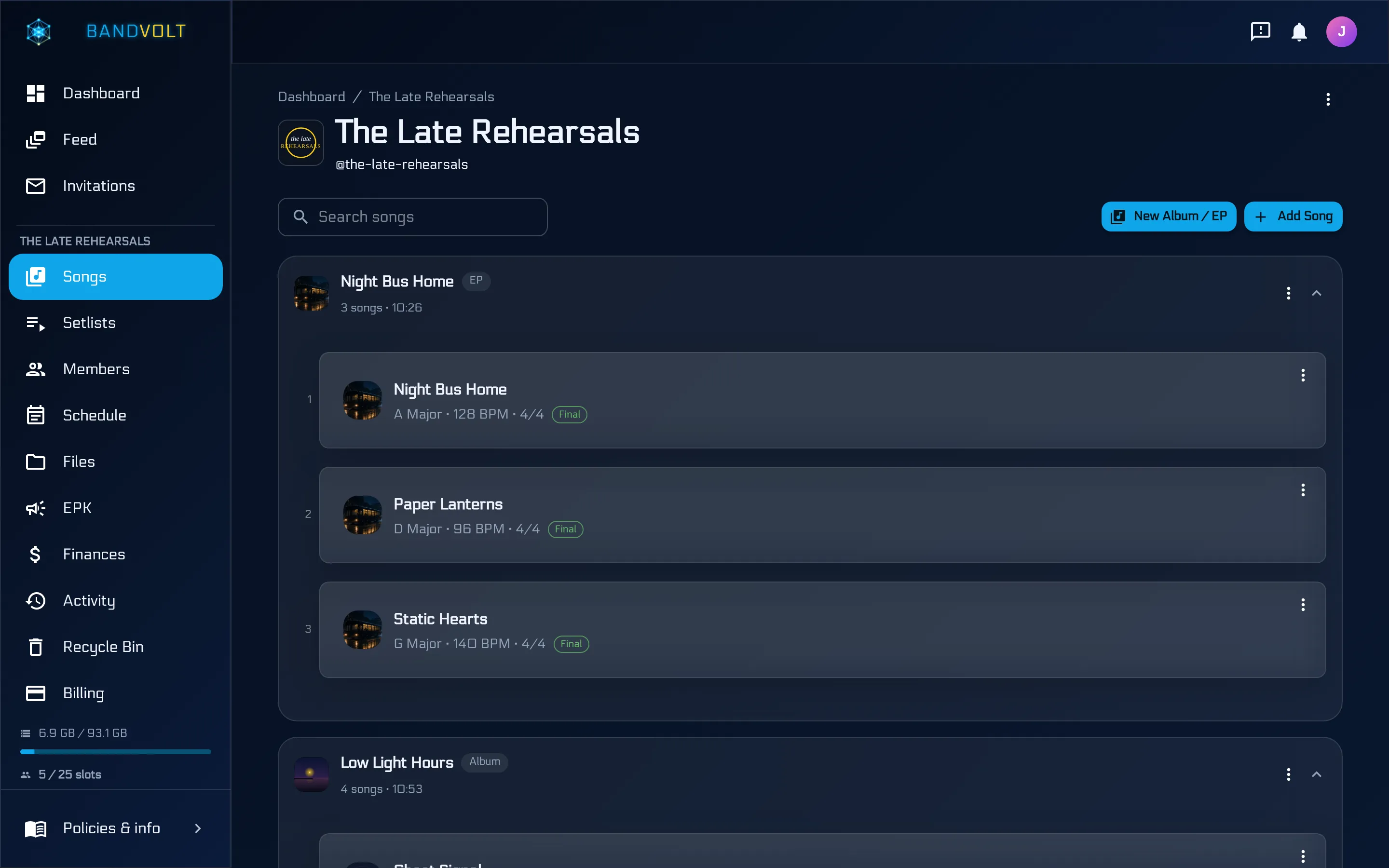
The short answer: an indie band stays organised by keeping six things in one shared place - song versions, feedback, setlists, the gig calendar, files, and money. BandVolt is a band management app built around those six. The Basic tier is free, with no credit card, and the band pays once if it upgrades. Members do not each buy a seat.
Nobody in an indie band signed up to be an administrator. Somebody becomes one anyway. They keep the Drive folder, chase the deposit for the support slot, and know which bounce is actually the latest. When they are busy, or they leave, the band discovers that the organisation was a person.
This is the system that person wishes was written down. It works if you build it out of other tools. BandVolt is the version where the six pieces already share a workspace, so the setlist knows the songs and the gig knows the setlist.
1. One home for the songs
Every demo, voice memo, and mix goes to the same place, as a version of the song it belongs to. Not as final_final_v3.wav in a chat. Each upload is labelled, dated, and listed in order, with its own waveform, and the audio is the file you uploaded. Nothing is quietly re-encoded to save space.
Set the mix the band should be hearing as the active mix. Mark a final when you mean the song is done. Key, BPM, time signature, lyrics, and artwork sit on the song, which is what makes the later steps - a setlist, a public page - possible without retyping. Group songs into albums, EPs, and collections when a release takes shape, and move a song between them without uploading it again.
The walkthrough video on this page is that library: albums and EPs, adding a song, the order, the artwork, the status. The habit underneath it is in from rehearsal room to release. The argument against a folder full of renamed bounces is mix version control.
Invite the band once, by username or email. Each person gets their own login. There is no shared password in the pinned message, and you can revoke someone when they leave without locking everybody else out. That roster is members.
2. Feedback on the track, not in the chat
“The vocal is buried after the second chorus” is useless three days later in a group chat, because nobody can find the message or the file it referred to. Pin the note to the second, on the version it belongs to. Reply in the thread. Resolve it when the change has been made. The mix engineer works from a punch list instead of a scroll.
If the thread gets long, AI Mix Summary reads the unresolved comments and distils them. That costs 1 Volt. The comments stay where they were. How to read the result, and when it is a waste of a Volt, is in what the band is really telling you. The commenting itself is timestamped feedback.
A producer or a session player who needs to upload a take does not have to become a band member. On Premium you can invite them to one song or a whole album, as a Contributor or a Reviewer, and they never see the rest of the workspace. That is a separate job from the weekly lineup, covered in working with session players.
3. Setlists that match the show
Build the set from your own library, so the key, the BPM, and the length come with the song. Each setlist can use any version - the recorded cut, or the longer live arrangement - and unreleased songs go straight in. A streaming playlist cannot do either of those, which is the whole of Spotify playlist vs a real rehearsal setlist.
In rehearsal, playback mode puts the key, BPM, lyrics, and time signature on screen. When you need paper on a monitor, Print gives you a numbered sheet from that same list. Link the setlist to the gig, or to several gigs, on the calendar. The feature page is setlists.
4. A calendar everyone actually checks
Gigs, rehearsals, and studio days go on one shared calendar. Date, time, location, description. Attach the setlist. Attach the rider and the stage plot to the show they belong to. Flag the public gigs and they show up as upcoming dates on the EPK, so you are not maintaining a second list.
“When is practice?” stops being a weekly message, because the answer is the calendar. The habit - add the gig the day it is confirmed, including the load-in - is in the gig nobody put in the calendar. The calendar itself is here.
The rider, the plot, the press shots, and the contracts also need a home that is not a song. That is band file storage: folders every member can reach, full quality, with a 30-day recycle bin. The 11pm version of that problem is what to send a venue.
5. The money, written down when it happens
Indie band finances fail on memory, not on arithmetic. Someone fronted the fuel. Someone else took the cash from the door. In December nobody agrees the numbers, and the argument feels personal because the record was personal. It lived on one laptop.
Log gig fees, merch, and expenses in a shared ledger, with the receipt on the entry. Set the rehearsal room to recur. Look at the year when you need it. Everyone sees the same figures, which is what makes a split a five-minute conversation. How bands actually divide the money is in splitting band income without the awkward meeting. The ledger is band finances.
6. Sending music out without making people sign up
A label, a promoter, or a playlist curator will not create an account to hear one song. A public share link gives them a page and a play button. Basic bands can keep three song links active. Premium adds unlimited song links and a link for the whole album or EP. Revoke a link when you are done with it. You choose whether it follows the active mix or stays on the version you sent.
For a booker who needs the story as well as the music, the Electronic Press Kit is free on every tier: bio, tracks, photos, videos, a booking contact, and the shows you flagged. Viewers do not need an account. When to send a song link, a collection, or the EPK is in send your music to anyone, no account needed.
What it costs
Basic is free. 1 GB of storage, 10 Volts a month, the EPK, up to three active song links, 10 workspace slots for members, versions, comments, setlists, the calendar, and the ledger. No card.
Premium is £9.99 a month for the band, not per person, or £89.99 a year. For a five-piece the monthly price is about £2 each, and the annual price works out at about £1.50 each. You get 25 workspace slots shared by members and collaborators, 50 GB, 200 Volts a month, unlimited song links, public album and EP links, external collaborators, content transfer, and membership of unlimited Premium bands. Need more room on Premium? Packs of 10 slots are £2.49 a month, and storage packs add 50 GB. The current list is on the pricing page.
A slot is one person with access. A member uses one. A collaborator uses one. The same person on ten songs still uses one.
Start on Basic. Upgrade when the free limits are the thing in the way - the storage, the three links, or a producer who needs to work on the songs without joining the band. Do not upgrade because a checklist told you to.
Frequently asked questions
What does an indie band actually need to stay organised?
Six shared things: the songs and their versions, feedback on those versions, setlists, a calendar for gigs and rehearsals, the non-music files, and a ledger. If each of those lives in a different app with a different login, someone in the band becomes a full-time administrator.
Does every member need their own paid account?
No. BandVolt is priced per band, not per person. Each member has their own free login. Basic is free for the band. Premium is £9.99 a month for the whole band, or £89.99 a year.
What is included before you pay anything?
The free Basic tier includes 1 GB of storage, 10 Volts a month, a public Electronic Press Kit, up to three active public song links, 10 workspace slots, song versions, timestamped comments, setlists, the shared calendar, and band finances. No card is required to start.
When is Premium worth it for a small band?
When you need more than 1 GB, more than 10 people with access, unlimited song links, a public link for a whole album or EP, external collaborators, or content transfer to hand a finished record to another band. Premium is £9.99 a month with 25 slots and 50 GB.
Can one person run two bands on the free tier?
You can be an active member of one free band at a time. Premium band memberships are unlimited, which is what you want for a side project, a second act, or a roster.
Topics: band management app · band management software · tools for indie bands