

Splitting band income without the awkward meeting
How bands actually split gig money - even splits, expenses-first, and points systems compared - plus why a shared ledger turns Sunday afternoon negotiations into a five-minute glance.
By @KHeavy · Updated 1 August 2026
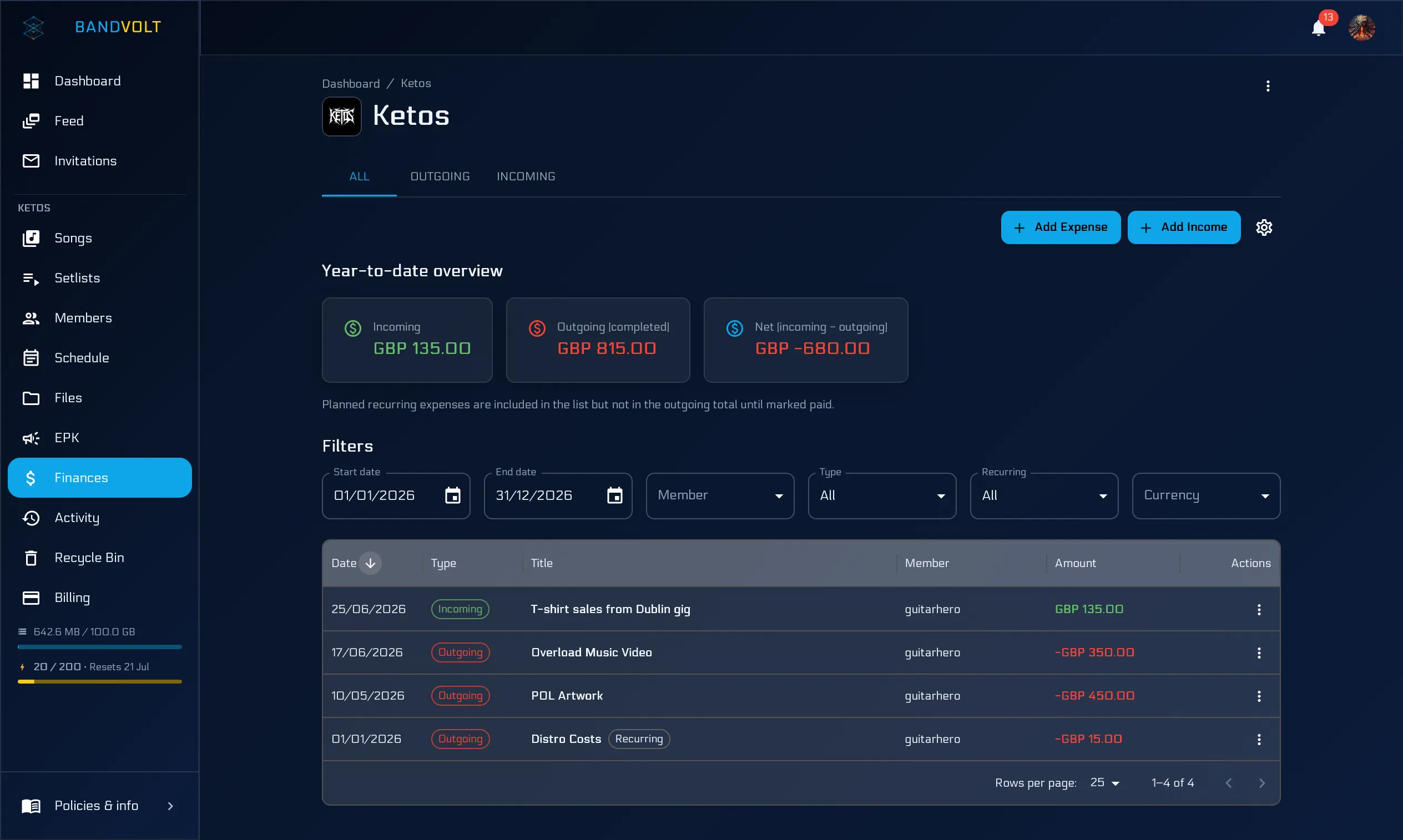
The short answer: the fairest way to handle band money is a shared ledger every member can see - every gig fee, every expense, every receipt in one place. BandVolt builds this in, so who is up and who is down is a glance, not a meeting.
Money is the quietest reason bands break up. Not the loudest, not the most dramatic - the quietest. It builds in the background while everyone smiles through it.
Someone fronted the cash for strings. Someone else paid the rehearsal room. The pub gig paid £180 but the bassist drove and put in £30 of fuel. Who is up, who is down, who forgot the receipt?
You should not need a forensic accountant to play a Friday show.
The real problem is not the split
Ask a band how they split money and most will say “evenly” without hesitating. Ask them who is currently owed what and the room goes quiet.
That gap is the whole issue. The disagreement is rarely about the rule - it is about the record. Nobody is disputing that the bassist should get their fuel back. The problem is that the fuel receipt is in a jacket pocket, the £180 went into the drummer’s account because they were nearest the promoter, and the only person who knows the current state of things is whoever has been keeping it in their head.
So the money conversation becomes an act of memory and trust, held under mild social pressure, usually after a gig when everybody is tired. That is a bad format for a conversation, and it is why bands avoid it until it has become a big one.
Three ways bands actually split money
There is no correct answer, but there are three common models and each fails in a different way. Pick one deliberately.
Even split, no expenses
Everyone gets an equal share of the fee. Simple, fast, and quietly unfair: the person with the car and the person who buys the strings are subsidising everybody else. Works fine for occasional local gigs where costs are near zero. Corrodes badly once there is travel.
Expenses first, then even split
The band’s costs come out of the fee - fuel, room hire, consumables, whatever somebody fronted - and the remainder is divided equally. This is the most common arrangement and generally the fairest for live income, because it recognises that some members spend more to get to the same stage.
Its one requirement is bookkeeping. It only works if expenses are actually recorded, which is exactly where most bands fall down.
Points or weighted shares
Some bands weight shares - a member who books gigs, drives the van, or owns the PA takes a larger cut. This can be entirely reasonable, and it is also the model most likely to breed resentment if it was never explicitly agreed. If you use it, write it down, and revisit it when circumstances change.
Whichever you choose: decide it when there is no money on the table. Agreeing a split while looking at cash is negotiation. Agreeing it in a rehearsal room in January is admin.
Keep performance money and songwriting money separate
This is the single most useful distinction for keeping a band together, and it gets blurred constantly.
Performance income - gig fees, session work, a support slot - is usually split evenly, because everyone turned up and played.
Songwriting and publishing follow whoever actually wrote the song, and those shares can be very unequal in a band where one or two people write.
Bands run into trouble when they let one compensate for the other: “you write everything so you should take more of the door” or, worse, “we all split the writing evenly because we all split the gigs evenly”. Both are decisions you can make - just make them consciously, and write them down separately, because they behave completely differently over time. A gig fee is spent by Tuesday. A songwriting share is still paying out in ten years.
A ledger everyone can see
BandVolt gives every band a shared ledger. Income on one side, expenses on the other. Anyone can log a payment. Anyone can upload the receipt for a string set or a van hire. The running total updates in front of the whole band.
No spreadsheet only one person can edit. No screenshots of bank apps. No private notes about who owes who.
The thing that changes is not the arithmetic - it is who has to hold it. When the record is shared, nobody is the band’s accountant by default, and nobody has to be trusted on the numbers because everyone can see them.
Recurring costs that do not surprise you
Rehearsal rooms, streaming distribution, storage subscriptions - log them once as recurring and they show up automatically. Month-end is not a shock.
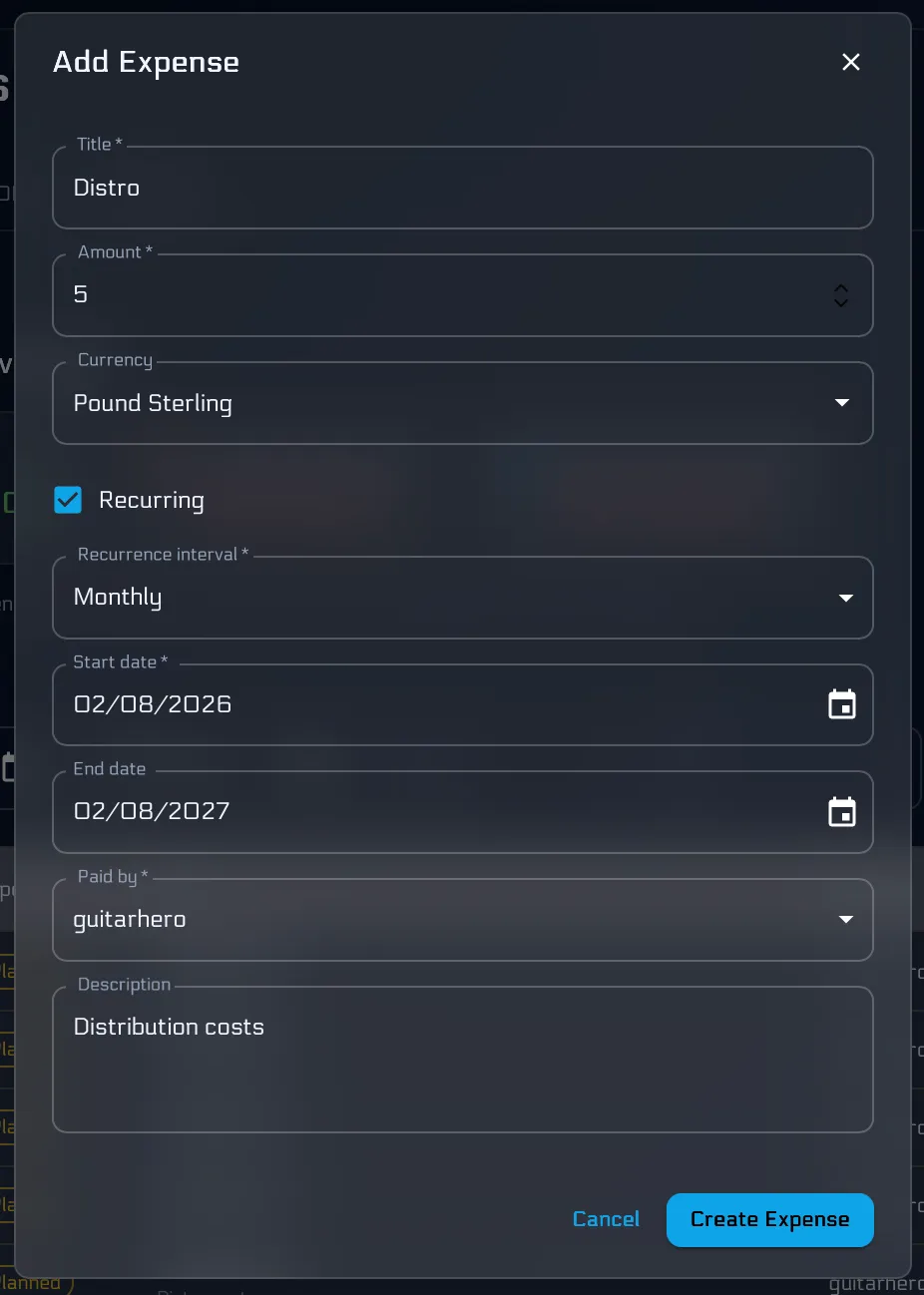
Recurring costs are also where bands most often lose track of their real financial position. A room at £40 a week is £2,080 a year, which is a fact that tends to arrive as a surprise when it has never been written down anywhere. Seeing it as a line item changes decisions: it is the difference between “we can’t afford to record” and “we could record if we dropped to fortnightly rehearsals for two months”.
Habits that make it work
The tooling only helps if a few small habits go with it.
- Log it at the venue. Not tomorrow. The whole system depends on capture happening while somebody still has the receipt in their hand.
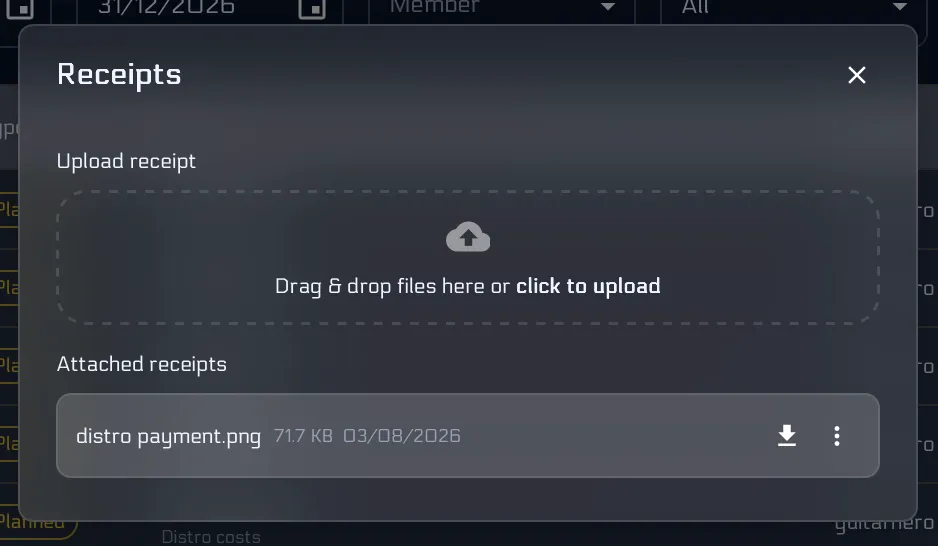
- Photograph receipts immediately. Thermal paper fades, and a faded receipt is an argument waiting to happen.
- Do a five-minute review once a month. Not a meeting - one person glances at the ledger and flags anything odd in the group chat.
- Settle up on a schedule, not on a mood. Monthly, or after every third gig. Something predictable, so nobody has to raise it.
- Write the agreement down somewhere the band can find it. A pinned note beats four different recollections.
The conversation gets easier
Because the numbers are visible all the time, the band money conversation is not a confrontation. It is just a glance. Decisions get faster. Trust gets stronger. Sunday afternoons get shorter.
And the quiet resentment - the thing that actually breaks bands - never gets a chance to build, because there is nothing to be quietly resentful about when everyone can see the same page.
Open a band ledger today - free, with receipts and recurring costs included. More on how it works on the band finances page.
Frequently asked questions
How do bands usually split gig money?
The most common approach is expenses first, then an even split of what is left. The band is reimbursed for fuel, strings, room hire, and anything else somebody fronted, and the remainder is divided equally between members. Even splits with no expense handling are simpler but quietly punish whoever drives and whoever buys the consumables.
Should the songwriter get a bigger share of gig money?
Live income and songwriting income are different things. Performance fees are usually split evenly because everyone played the show, while songwriting royalties and publishing follow whoever wrote the song. Mixing the two is where most band money arguments start, so agree them separately and write both down.
How should a band handle expenses somebody paid personally?
Log it the moment it happens, with a receipt, in a place the whole band can see. The problem is almost never the amount - it is that three weeks later nobody can remember whether the £42 was reimbursed, and asking feels petty. A shared ledger removes the need to ask.
Does a band need a business bank account?
Once money is moving regularly it makes life much easier, because it separates band money from anyone's personal money and gives you one statement to reconcile against. It does not replace a shared ledger - a bank statement tells you what moved, not what it was for or who is owed.
What should we do with money the band has left over?
Decide before you have it. Bands that agree in advance what the float is for - recording, merch, van repairs - argue about it far less than bands who discover they have £600 and no shared plan. Keeping the running balance visible to everyone makes that conversation a decision rather than a negotiation.
Topics: how do bands split gig money · band income split · band finances