

Spotify playlist vs a real rehearsal setlist
Many bands rehearse to a Spotify playlist. Here is what it can't do - unreleased songs, live arrangements, keys and BPM - and what a purpose-built setlist tool does instead.
By @KHeavy · Updated 26 October 2026
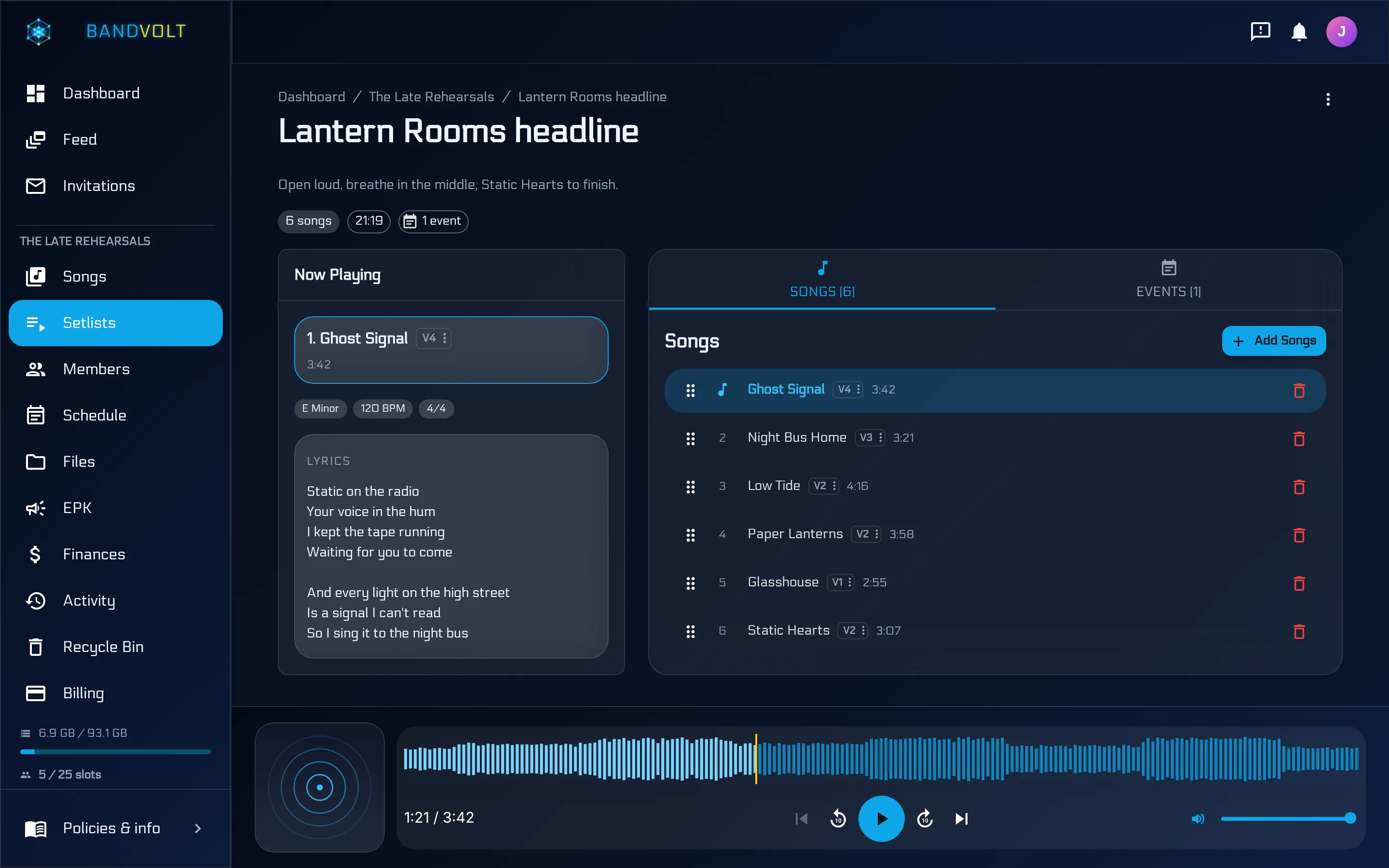
The short answer: a Spotify playlist can only hold released songs, in the form they were released, with no key, BPM, or lyrics in view. A band rehearsing its own material ends up practising a set it will not play. A setlist built from your own library can hold any version of any song, including ones nobody has released, and it can show the key, the tempo, and the words while you run it. BandVolt’s setlists do that on the free tier.
The playlist is the default for a reason. Everyone has the app, it takes two minutes, and it plays through a speaker in the room. For a covers band learning a standard from the original recording, it is honestly fine, and cover and wedding bands still use one to learn the original record. Keep it.
For a band playing its own songs, it fails in four ways that do not show up until you are on stage.
1. Your unreleased songs cannot go in it
The new single is out in six weeks and you want it tight before release day. It cannot go in a streaming playlist. Spotify’s local-files trick will play a track on the phone that has the file. It does not put that track in front of the rest of the band. Someone still has to say “skip this one, we’ll run it off my laptop”, and the laptop has a bounce from a different week than the one the singer has been learning.
A setlist built from the band’s library has no such gap. Anything you have uploaded - a demo, a rough, a master - slots into the set, and every member hears that file. The new song is just a song. There is a longer version of that habit in the five-minute setlist.
2. It only knows the released version
Live, the songs have drifted. The intro is longer. The ending is a chord instead of a fade. The festival slot needs the edit that gets to the chorus faster. A playlist can only play the album cut, so the band rehearses lengths, endings, and transitions that will not happen on the night.
In BandVolt a song is a version history, and each setlist chooses which version it uses. Pin the live arrangement on the headline set. Pin the short edit on the festival set. Or leave an entry following the active mix when the recording and the live version are still the same file. The album cut and the live bounce are both in the library. You do not upload the song twice to have both.
That choice is the whole subject of rehearse the live version, not the album cut. The practical test is the clock. If the rehearsal set’s lengths add up to the album and the slot is eight minutes shorter, you have been practising the wrong show.
3. No key, no BPM, no lyrics
A playlist shows artwork and a progress bar. It does not tell a dep what key the song is in, give the drummer a tempo for the count, or put the second verse in front of a singer who has not played the song since August.
Those fields live on the song: key, BPM, time signature, lyrics. Playback mode in a setlist puts them on screen for the current song, with the version that setlist selected already playing. The band stops hunting a lyric sheet and a note in someone’s phone that says “capo 2, but check”.
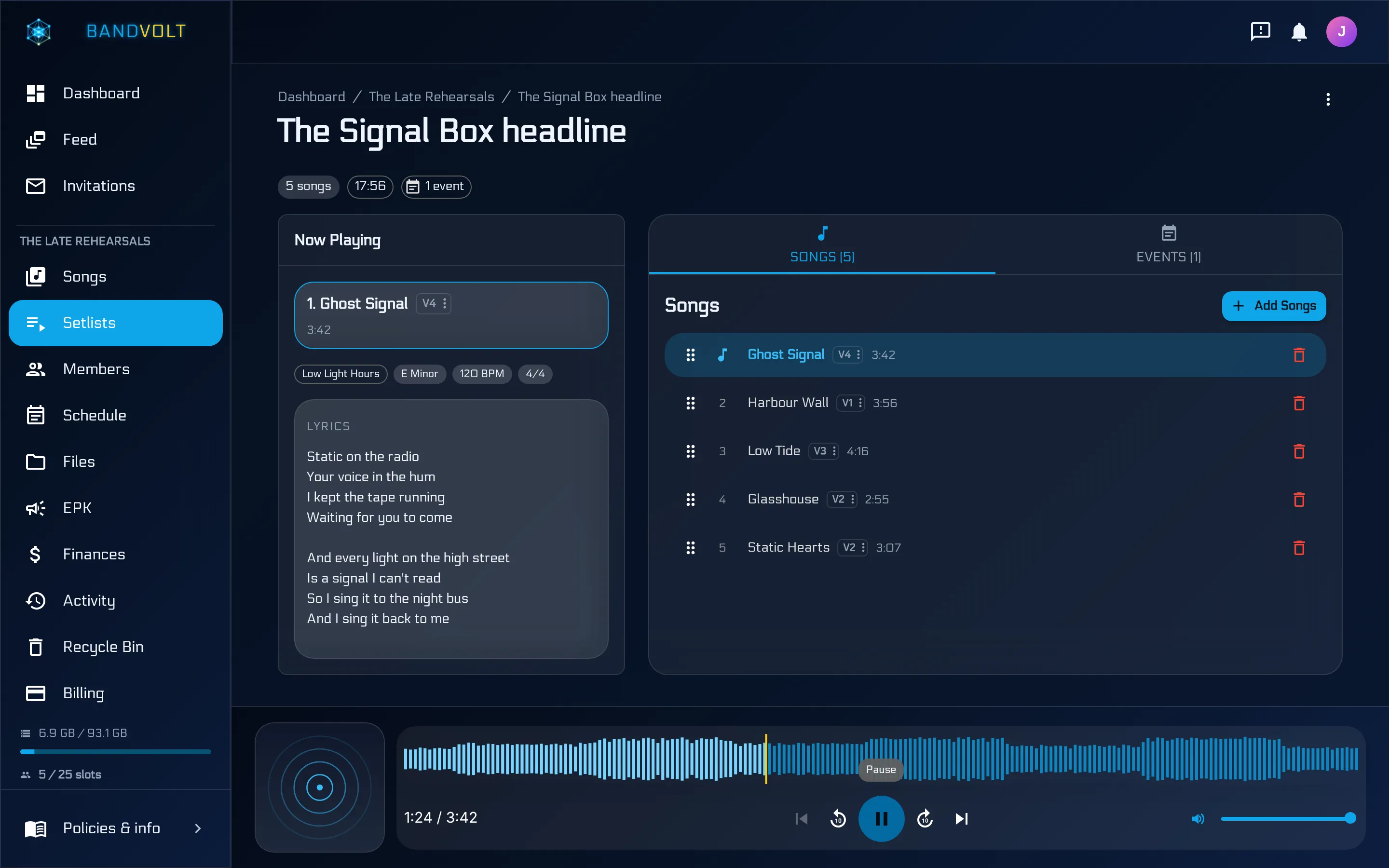
The length next to each title is the other half. A set is a time budget. Knowing you are at 34 minutes before you walk into a 30-minute support slot is the difference between finishing the last song and being waved off during it. The playlist will not add your songs up against the slot, because it does not know the slot exists.
4. It is not connected to the gig
The playlist does not know which show it is for. Which set are we running on Saturday? Is this the one with the new song, or the one from the last rehearsal photo? Someone checks the chat, and two people are looking at two screenshots.
Setlists link to gigs and rehearsals on the shared calendar. One setlist can be linked to several events when the same set runs all weekend. Each show still has its own rider and stage plot on the event. When the slot changes, you edit the list once and everyone sees it, including the next print. The failure mode, when the date never makes it out of the chat, is the gig nobody put in the calendar.
Print, from the setlist, is a numbered stage sheet: title and song order, large type, for a music stand or a monitor wedge. It comes from the same list you just rehearsed. It is not a photo of a document that was already out of date when it was photographed.
How to build the rehearsal set so the gig matches it
- Make the setlist for the show, not a generic “rehearsal playlist” that drifts away from Friday.
- Add the songs from the library and drag them into the order you will actually play. Open with something you can play cold. Put the best-known song where the room needs it, not automatically at the end. The sequencing notes are in the five-minute setlist post.
- On each song, pin the version you will play live. If that version does not exist yet, bounce it and upload it before you rehearse. Do not rehearse the album and hope.
- Link the setlist to the gig, and to the rehearsal, so both dates point at it.
- Run playback mode in the room. Read the key and the lyric off the screen. Check the total length against the slot before you add another song.
- If the promoter cuts ten minutes, edit the list, print again, and walk in with the new one. One source.
When the playlist is still the right tool
Learning a cover from the record. A listening party. A warmup playlist while people are still plugging in. Streaming is good at playing released music to a room.
The moment the set includes your own songs, your own arrangements, or anything that is not out yet, you have outgrown it. The playlist can stay on someone’s phone for the journey. The set the band prepares from should be the one that knows the versions, the keys, and the gig.
The walkthrough under this post is the build: pick the songs, put them in order, choose the mix, link the show.
Frequently asked questions
Can you rehearse a band set from a Spotify playlist?
You can, if every song is a released recording and you are happy to play it in that form. The moment the set includes an unreleased song, a live arrangement, or a shorter edit, the playlist is no longer the set you will play.
Why can't unreleased songs go in a shared Spotify playlist?
A streaming playlist only holds tracks the service already has. Local files can play on the device they were added on. They do not show up as that song for the rest of the band in the shared playlist.
What should a rehearsal setlist show besides the titles?
Key, BPM, time signature, and the lyrics, plus the length so you know whether the set fits the slot. In BandVolt those come from the song, and playback mode puts them on screen while the chosen version plays.
Can one setlist be the album cut and another the live arrangement?
Yes. Each setlist entry can pin a version of the song, or follow the active mix. The headline set and the short festival set can use different edits of the same songs without a second upload.
Do setlists cost extra?
No. Setlists are on the free Basic tier, including playback mode and a printable stage sheet. The same list links to gigs and rehearsals on the shared calendar.
Topics: setlist app · Spotify playlist for band · rehearsal setlist