

Rehearse the live version, not the album cut
BandVolt setlists can use any version of a song - album cut, extended live arrangement, or abridged edit - plus unreleased tracks no streaming playlist can hold.
By @KHeavy · Updated 26 October 2026
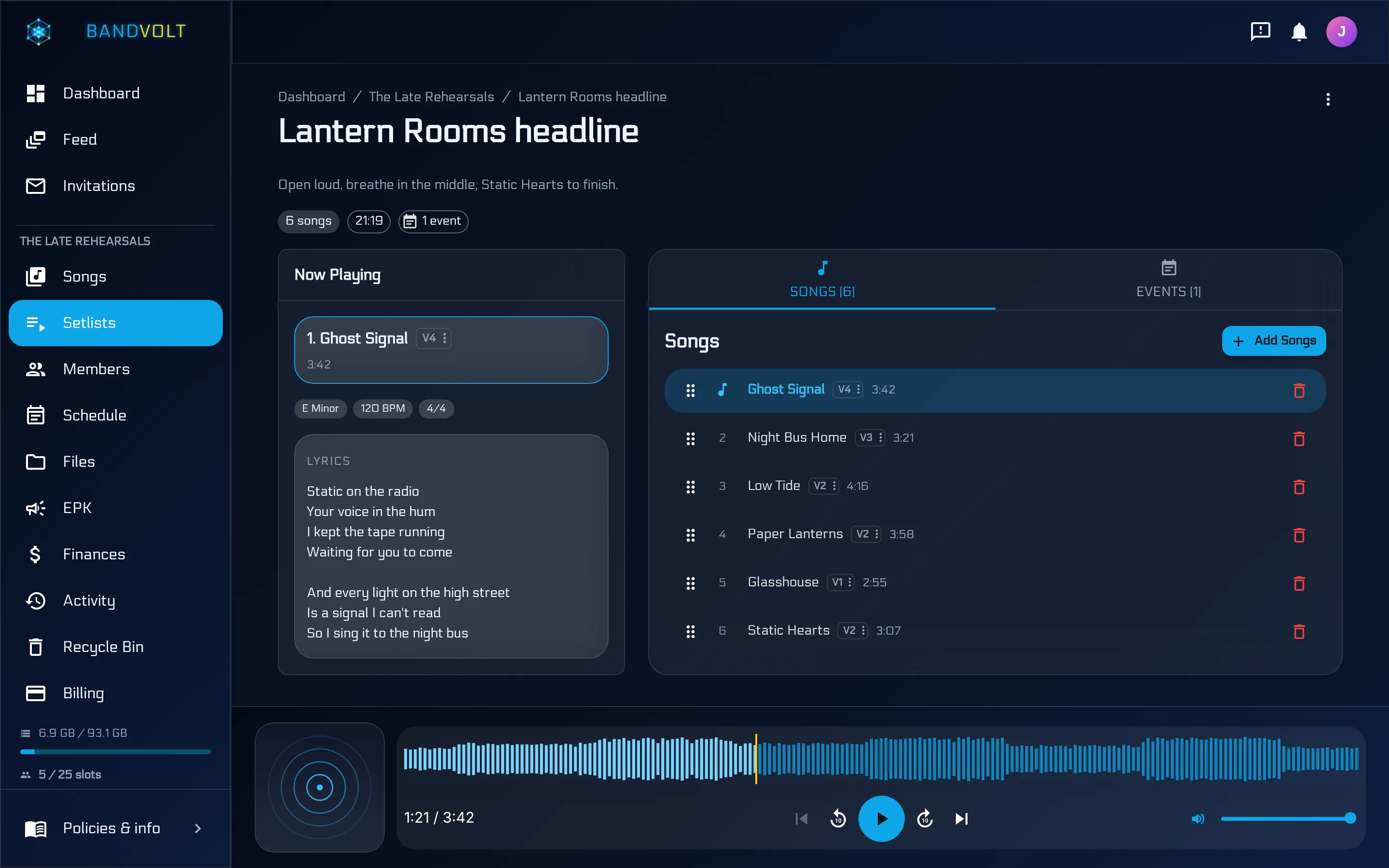
The short answer: every song in BandVolt keeps its full version history, and each setlist can point at whichever version you choose. Rehearse the extended live arrangement, play a shorter edit in a short slot, and drop unreleased songs into the set. A streaming playlist can only play the released master. Setlists are on the free Basic tier.
Most bands do not play their songs the way they recorded them.
The album cut fades. Live, it ends on a chord you can actually finish. The single is 3:12. The live version grew an extra chorus and a solo that picks up a bar every tour. The festival slot needs the edit that reaches the hook before the sound operator starts looking at the clock.
So the band rehearses the album, because that is the file everyone can find, and then plays something else on the night. The transitions you needed to practise are the ones you meet for the first time in front of people.
Why the album cut wins the rehearsal
It is the file with the artwork. It is on people’s phones. It is the one a playlist can hold. None of those are musical reasons. They are availability reasons, and they are enough to make a whole band practise the wrong arrangement for a month.
A streaming playlist can only hold what has been released, in the released form. Your extended live arrangement is not on it. Your short edit is not on it. The new song you are road-testing is not on it either. The comparison is in Spotify playlist vs a real rehearsal setlist. The fix is not a better playlist. It is putting the live bounce where the setlist can see it.
Record the version you play, then pin it
You already have the live arrangement. It is the one you played last time. It might be a soundboard recording, a phone at the desk, or a bounce you made on a day off so the band could hear the longer ending. Upload it as a new version of the same song. Label it so a stranger in the band can tell it from the master: “live arrangement”, “festival edit”, the month if you revise it.
Do not make it a second song. A second song splits the comments, the lyrics, and the key across two places, and someone will update one of them. Versions stay on the song. The album master stays the album master. You can leave that master as the active mix, which is what a public share link will follow if you told it to follow the active mix. The setlist does not have to follow the active mix. Each entry can pin a version.
That split is the one that keeps the release and the show from trampling each other. Listeners of the single hear the single. The rehearsal plays the live bounce. If you want the public link locked to the release even after you change the active mix, pin the link to that version. The setlist pin and the share pin are two different choices. Use both on purpose.
One song, as many sets as you have slots
When you build the setlist, choose the version for that set.
The Friday club set pins the extended arrangement. The Saturday festival set pins the short edit of the same songs. A rehearsal on the Tuesday before Friday pins the Friday versions, because the rehearsal is for that show, not for the album. Link the setlist to the gig and to the rehearsal on the shared calendar, so both dates point at the same list. If the weekend is one set played twice, link that one setlist to both events instead of keeping two copies.
Playback mode still shows the key, the BPM, the lyrics, and the time signature. It plays the recording you pinned, so the count-in matches the track in the room and the words on the screen match the arrangement you are about to sing. If the live version has a different lyric in the bridge, put that lyric on the song, or keep the live lyric in the version you are actually running. Do not leave the album lyric up and hope people remember the change.
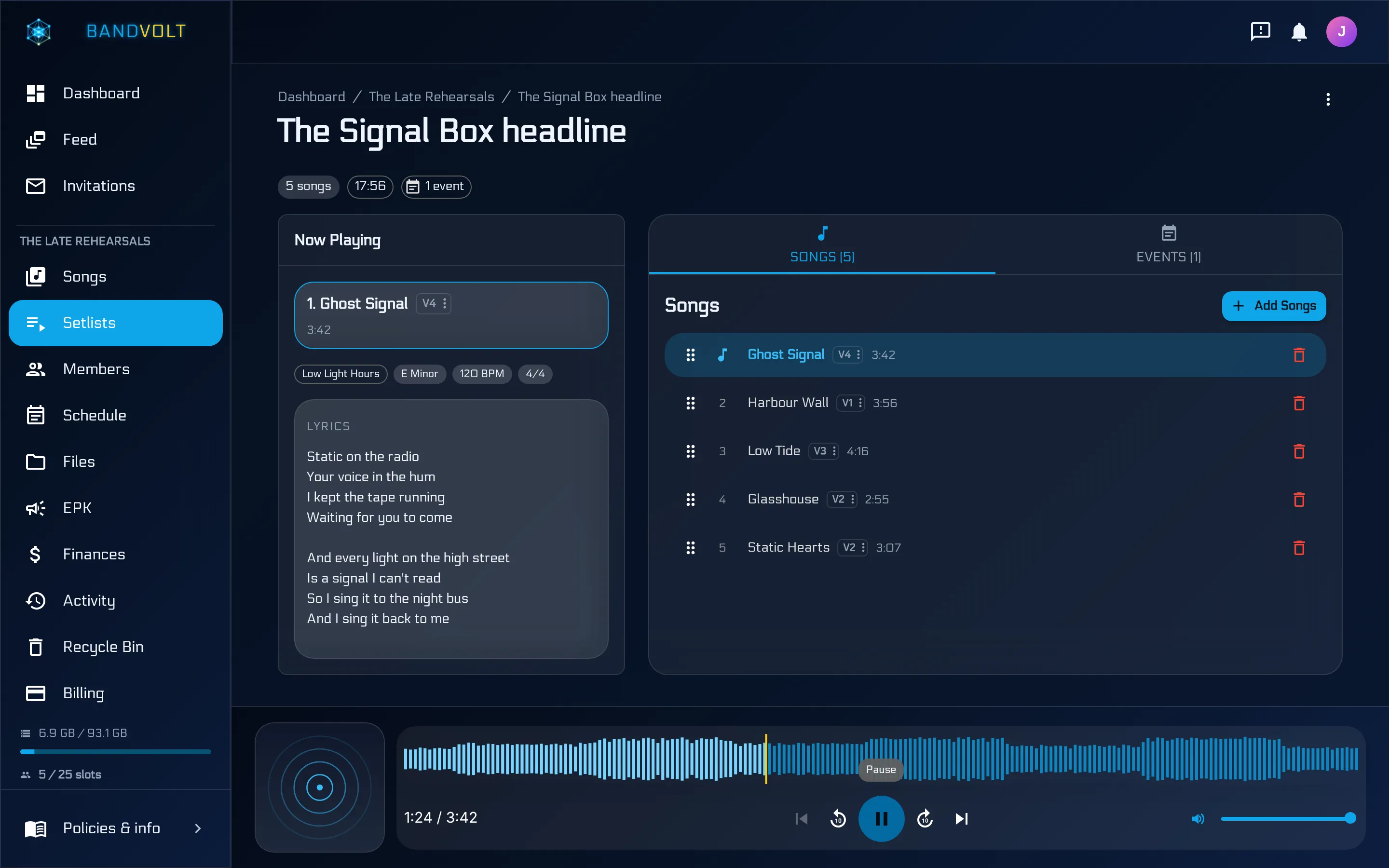
Then look at the total length. The album timings are a lie if you are playing the long endings. The setlist timings, on the pinned versions, are the slot you will actually occupy. Cut or add before you are standing on the stage being asked to finish.
Print the stage sheet from that list when you want paper. Numbered titles, large type, the same order you rehearsed. The print is not a second document you then have to remember to update.
Unreleased songs are the same mechanism
Anything in the library can go in the set. A song that is not out yet is just a song with a version. Pin the demo you want to road-test. When a better mix lands, either point the setlist at the new version or, if the entry is following the active mix, set that mix active and the set follows.
Road-test the new single for a few shows before release day. There is no “skip this one on the playlist, we’ll run it from my phone”. The phone was always how arrangements got lost: three bounces, two of them in a chat, and a singer who learnt the wrong one.
A rehearsal that is honest about the show
Run the set in order, to the pinned versions, once, before you start fixing individual songs. You will hear the join between the long ending and the next count. You will hear that the short edit removes the bar the guitarist still plays out of habit. You will see that the lyrics on screen are the album words. Fix those in the room. They are the notes a playlist rehearsal cannot surface, because the playlist never contained the arrangement.
When the slot changes, edit the setlist once. The versions you pinned stay pinned. The gig, the rehearsal, and the next print all see the edit. That is also the five-minute version of building the list in the first place, in the five-minute setlist.
The walkthrough video on this page is the same controls: order the songs, choose the mix for each one, and link the set to the show.
Frequently asked questions
How do you rehearse a different arrangement from the recording?
Upload the live arrangement as its own version of the song, then pin that version on the rehearsal setlist and on the gig. The album master can stay the active mix for anyone listening to the release. The setlist does not have to follow it.
Can the same song be a different edit in two sets?
Yes. One setlist can pin the extended live version and another can pin a shorter edit. Both point at the same song in the library. You do not upload a second copy of the song to have a second arrangement.
What if the live version is only a phone recording of the last show?
That is still a useful version. Upload it, label it, and rehearse to it until you have a cleaner bounce. A rough recording of the arrangement you actually play is closer to the gig than a finished master of the arrangement you do not.
Do unreleased songs work the same way?
Yes. A setlist reads your library, not a streaming catalogue, so a song nobody outside the band has heard can sit in the set next to the singles. Pin the demo or the current mix the same way you pin a live edit.
Will the public song link suddenly play the live rehearsal bounce?
Only if that bounce is the active mix and the link is set to follow it. Pin the public link to the release version, or leave the album cut as the active mix and let the setlist pin the live one. The two choices are separate.
Topics: live arrangement · setlist versions · rehearsal